Sunday, May 16, 2010

Are we in Urubamba? Really?

I am not a luxury resort kind of guy, but I like to think that I know quality when I see it.  I saw it this weekend.


My mom, recently arrived from NYC,  was feeling awful in Cusco because of the altitude, and on a whim we hatched a plan to spend two days at a brand new hotel in Urubamba, a dusty little town best characterized as a rural weekend getaway for the upper crust of Cusco.  Mom, with the help of her friend Leslie, has elevated the practice of collecting frequent flier miles and credit card points to the level of a martial art, and was able to book us a $565/night room for, yes, nothing.  


The Tambo del Inca just opened its doors two weeks ago, nearly a year behind schedule, and still somewhat prematurely.  We were given a tour of the amazing facilities only to find out that many of them were not yet functioning.  We saw steam rooms with glowing constellations built into the ceilings, five different saunas, therapy pools with soothing udnerwater lights undulating between greens and purples, and a gorgeous pool that began indoors and then vaulted outdoors to a perch overlooking the Vilcanota river.  With mouths agape we were slapped in the face by the fact that virtually none of these attractions were ready yet.  We could look, but that was it.  Isabel and Sophia took the news like champs, but we were all quite disappointed.  But once all those goodies are up and running, man, if you are planning a trip to Peru, by all means try this place out!


Our room was stunning and oh so very quiet.  The whole place in fact was eerily silent and empty.  With the hotel recently (and marginally) opened, the number of uniformed and perfectly groomed employees far outnumbered the guests.  All those workers evoked the image of Dr. Evil's henchmen, making the whole place feel like the elaborate hidden lair of some super-villain from a James Bond movie.  I kept expecting to brush against a concealed button and have intercontinental-ballistic missiles slowly emerge from the floor in preparation for launch.  Adding to the mystique, the buildings that make up the hotel are completely invisible from the road and sit low on the land, following the contours of the river bank.  As you walk in the front door the floor falls away four stories to the dining room below whose center is occupied by a stone chimney 50 feet wide by 15 feet deep.


We had a relaxing time walking the grounds, partaking of the sublime shower and playing scrabble on the deck. 


The hotel is building their own mini-train station and will soon be offering single ferro-car train service to Machu Picchu, avoiding the usual circus of finding lodging, getting train tickets on PeruRail and entrance tickets to the ruins themselves.  Travelers will just get on a bus at the Cusco airport and Tambo del Inca will take it from there.  


I can't really fathom what the inhabitants of Urubamba make of this place.  The price of a lunch entree is more than what most people make in a month in this agricultural town.  From the elaborate wooden deck with over-sized couches, adobe houses are visible through the eucalyptus branches, perched precariously on cliff edges across the river.  I can only hope that such a high-end hotel will bring money to the town and provide more opportunities for the folks living in those mud homes, with a bird's eye view of another world just outside their dusty windows.  

Sunday, May 2, 2010

School Days, Cool Days

The perfect school may be right here in Cusco.


Isabel and Sophia had the great fortune of being admitted to the Peruvian equivalent of a charter school for this academic year.  They attend Pukllasunchis ("pook-ya-soon-chees) which means "Here, we play" in Quechua.  We had heard of Puklla from a few acquaintances but didn't have the connections to get the girls in when we first arrived.  By October we had made a new friend, Amy Bakal, an ex-pat from the upper west side of Manhattan.  She has two daughters, both of whom attend/ed Puklla and she arranged for us to have a private audience with the school's principal, Raul.  In short, he agreed to let our girls in, knowing they would bring a taste of North American culture to the school and would be leaving after half the year (the school year here begins in March and winds up in December).  So, intrepid little souls, they walked into this new place on March 1st not really knowing what to expect.

The physical setting of the school is stunning.  Its adobe and live-edge wood buildings are wedged into a tight drainage, sharing the valley floor with a small river running through the grounds.  Even though the valley is narrow there is a sense of openness and space to the campus.  Isabel returned home one night complaining of a blister on her finger.  Instead of making paper maché dolls or the like in art class in the US, both she and Sophia have learned to spin wool with a drop-spindle and Isabel is almost done weaving a belt on a back-strap loom!  She also reported this week that she can play "Yesterday" on the guitar thanks to the lessons she is receiving as part of music class.  One night at dinner Sophia grabbed the 8 inch chef's knife claiming that she had learned how to cut in cooking class.  Yes, that's right, kindergartners take a cooking class.  While skeptical at first, it turned out that she was pretty adept at cutting slices of cheese for us at dinner.  Boy, was she proud.

Way back at the start of our trip to Peru we became friends with a family from Denmark who were traveling the world in a super-converted 1986 VW bus.  They spoke almost no Spanish, but were driving themselves around some of the most remote sections of the Andes in their bus, named Mary.  They had three kids, aged 7, 9 and 10, and they were all totally committed to the experience.  It turned out that both Dennis and his wife were archers, Dennis missing the 2008 Olympic Qualification round by 2 millimeters.  Our American girls were definitely more reserved than their Danish kids who were crossing streets by themselves and climbing up anything steep they could find in the countryside.  I sat with Dennis and Birgitte one morning over tea and had an intense conversation about child rearing.  Dennis told me about a time when one of his sons had become obsessed with fire and nearly set the house ablaze while experimenting with matches.  Instead of scolding him, Dennis marched him into the woods near their house and built a proper bonfire.  Once the fire was reduced to ashes he allowed his son to handle the still blazing embers and they burned his hands.  He didn't burn his son's hands, he just let him explore and through this experience (and the permission to do it) his obsession with fire waned and eventually disappeared.  Both Dennis and Birgitte were big proponents of allowing children to take reasonable risks in order to map out and understand their world.  I felt a bit defensive at first, but realized that I had done the same thing for myself once I left the house at the age of 17.  My parents were at least as protective with me as I am with my children, and I survived a series of mishaps as I began to make my way in the world as an independent adult.  I learned a great deal from each of my mistakes and continue to navigate my world guided, at least in part, by some of these early lessons.  The Danes had a point,  why wait until children leave the house to allow them to experience a little danger and excitement in their lives?

For precisely this reason, I am so happy that Isabel and Sophia are attending Puklla.  There are no English speakers there, so they are speaking, reading, writing and listening to Spanish all day.  They are making new friends, trying new foods, and learning how to be independent thinkers and doers.  They are also learning how to do "dangerous" things like cutting with a knife and collecting stones from the river bed.  They are doing what kids do best:  learning from experiences, exploring their world, and playing.

Last weekend was Pukllasunchis' Family Fun Day.  The entire school community met at the center of the city and walked, en mass, up to the ruins of Saksaywaman.  What began as a walk quickly turned into a deep and beautiful learning experience.  Half way up to the ruins we were handed a one page essay to read as we walked.  It was called "Grandma's Table."  The basic gist was that an old woman's husband dies, leaving her alone and unable to care for herself.  Her six children and their families gather to decide what to do.  No one wants the burden of caring for her and arguments ensue.  Eventually one of the woman's grandchildren sees her and comes running, arms outstretched, to embrace her grandmother.  At that moment it is decided, the old woman will live with the family of this grandchild, much to the relief of all her other children.  Once moved in, the old woman is sitting at the dinner table and, being old, has difficulty keeping food in her mouth.  Her son, disgusted, moves the old woman to a small table in a dark corner of the dining room, explaining that if she can't eat like a human being she will have to eat by herself.  A few days later the son walks by his daughter, the same granddaughter that hugged his mother that day.  She is busy building something with her blocks and her father asks what she is making.  "A little table for you to eat at alone when you get old and we have to take care of you" she replies.  The son, suddenly realizing his mistake, runs to the dining room and removes "Grandma's Table," inviting her to eat with the rest of the family from this point forward.

One of the teachers from the school then led our group of 30 people in a dramatic re-enactment of the story on the hillside next to the ruins.  I was cast as the "chair" and an actual old woman was cast as the grandmother.  She sat on my back as I knelt on the ground, greeting her grieving children as they came to offer their condolences one by one.  Then we wrote and performed a song telling the story of "Grandma's Table" and its moral.  Sophia took the whole thing in like the sponge that she is and was full of questions and "ah-has."

We then began a series of group initiatives and relay races in the fields above.  There was good food, we made new friends, we worked together, we had fun.  It was an enormously positive experience and I wondered if something like it could be pulled off in Maine.  Yes, probably, I thought.

So look for "Family Fun Day" at a public school near you in the 2010-2011 school year.  School isn't just about great experiences for kids, it works best when it's a family affair.  I am very grateful for Pukllasunchis, and even more so for the fact that our children get to go there.  We will all miss it!

Saturday, April 24, 2010

Come Together, Right Now

"Please kids, keep your feet and hands away from the police dogs.  Do not try to touch them."  Thus began the student assembly on the sun blasted concrete soccer field at school this morning.  The canine police team arrived exactly 30 minutes after they were supposed to, and marched onto the patio in synchronized lockstep with their dogs at their sides, necks straining against shiny chrome choke-collars.  As a prelude to the comparatively innocent "Pet Parade" scheduled for later in the day, these officers arrived to strut their stuff with their four legged partners.  The dogs, a Golden Retriever, a Rottweiler, a Doberman, and a German Shepard, were focused on each of their handlers in such a way that I knew they must either get great rewards for good behavior, or get the stuffing beat out of them for doing wrong.


There is a pompous and exaggerated style of marching here practiced by virtually anyone involved in a public function.  The straight legged-deadfaced-stare ahead- arm swinging can be seen in parades, civic functions, and on this day, across the concrete soccer field at school.  The dogs all sat up on their hind legs and "saluted" the kids surrounding them, they rolled over, they "stayed."  Betty, a teacher from Australia tapped me on the arm and said, "Smell that?  I think they've poured gasoline on something and their going to light it up."  "Plucky Australian," I thought to myself, " no one is pulling the wool over her eyes," and as if on cue, a uniformed assistant carried out two pairs of wrought iron rings covered in cloth saturated with gas.  As the assistant held a match to the rings they were immediately engulfed in flames sending dense plumes of black smoke into the crystal clear air.  A student grabbed Betty's sleeve and asked if she thought it was strange to do an activity causing so much pollution on the day after Earth Day.  "I reckon it is strange," she replied.

Astonishingly, three of the dogs jumped through the flaming obstacles without hesitation.  The fourth however, the German Shepard, would have nothing to do with it and steered away from the flames at the last minute each time his handler brought him near.  Smart dog, I thought.  After the show three students came up to me and commented on how sad they felt for the dogs.  I did too, but knowing the hellish existence that so many dogs experience here, I was glad that these four were at least being fed and cared for.

What exactly is it with school assemblies anyway?

In my seven years of classroom teaching I have seen some doozies.  Back in the states my all time favorite was the Karate teacher who arrived with his clan carrying a flashing boom-box.  Predictably, as he pressed play and cranked the volume up to 10 in the cafeteria, I heard the first staccato power-guitar chords of "The Eye of the Tiger" as blank faced kids went through the punching and grunting and kicking motions of their routine.  Ironically, the Sensei even looked a bit like Will Ferrel.  After the mullet inspiring 80's rock fest, his students went on to demonstrate how to disarm foes coming at you with you handguns, utilizing yellow and red rubber replicas.  What, I wondered, must the kindergartners be thinking?

Another assembly to remember was the visit from Rocco, the crime dog.  Rocco, a German Shepard,  was on the large side of his breed.  The two officers working with him needed a volunteer to put one of those "bite my arm" protection sleeves on, and defy them.  I was the lucky guy who got to play that role.  From across the playground the officers yelled for me to come over to them to which I replied "Make me!"  Enter Rocco.  He ran across that field at me like he was on a mission from God, and perhaps he was because he launched, superman style, from 10 feet away from me and locked onto my arm with the pinpoint accuracy of a surgical strike.  Yeah, Rocco could probably make me do anything he wanted.  Once he was done with me it was time for Rocco to find drugs.  That's right, the officers arrived at our rural elementary school with an ammo-box filled with pot and cocaine.  Really.  They planted both substances on the fourth grade teacher and let Rocco do his thing.  Again I wondered, what must the kindergartners be thinking?

While I have never seen a dog jump through a flaming hoop at a United States school assembly, it is a fair assumption that these events have a propensity for weirdness wherever they are staged.  Is it because the audience is captive?  Maybe it's the ultimate example of getting what you pay for.

Tuesday, April 20, 2010

Lose-Lose Proposition

No member of my family could rightly be accused of being a neat-nick.  Each of us leaves an assortment of clothing, sporting equipment, toys, books and electronic equipment lying in situ every day.  I think this had everything to do with us not noticing the absence of a few small and expensive items over the last few weeks.

During a mad series of trips and visits, Krista flew to Lima for a conference and some interviews only to turn around 12 hours after her return for an arduous trek with brother Matt and daughter Isabel.  It wasn't until a week later that she noticed her digital recorder with hours of interviews still in it was missing.  We also appeared to be missing a USB camera card reader.  We assumed that the recorder had perhaps been lost in transit from Lima, but Krista then remembered having it in her hands in our house before leaving for the trek.  None of us wanted to suspect either of our house keepers or Flor, our 10 year old neighbor, but we realized it might be any of them.  Then I went to get an iPod to listen to while I jumped rope and I couldn't find it.  Then Isabel noticed her wallet had been emptied.  We were being picked clean.

It always feels like you've been punched in the stomach when a situation that seemed safe and secure takes a turn for the worse.  Being somewhere between pragmatic and meat-headed, I called both our empleadas and asked them point blank if they had taken anything from the house that wasn't theirs.  I also found Flor on the street and subjected her to the same line of questioning.  No shocker here, they each categorically denied any wrong doing.  I guess I would make a pretty pathetic detective.  There is a cultural acceptance of NOT accepting responsibility around here.  I am told that even if I were to find the stolen items in a person's room, they would continue to categorically deny that they had anything to do with it.  To make matters worse, we consider each of the suspects to be our friend and stood to undermine our relationships with all of them.

In a typically Peruvian turn of irony, we were called by Rosalia just 24 hours after accusing her of stealing our belongings to ask if we might become the Padrinos of her high school graduation.  Not knowing how to handle such conflicting circumstances I turned to our friend Jean Jacques for advice.  He advised that I not get confused and go to the graduation party and have a good time -- the two situations had nothing to do with each other.  So that evening we were treated to roast lamb and potatoes carried from Rosalia's home community, ParuParu, by her mom and dad.  Her mom, Catarina only speaks Quechua, so she sat quietly while we spoke with Alejandro, Rosalia's dad.  The food was simple but exceedingly fresh and delicious.  With full bellies we boarded a cab to the function hall.  The techno-cumbia music blared out of oversized speakers hung from the ceiling as we entered the room, and it never really stopped the entire time we were there.  You see, this graduation was much more "disco" than "pomp and circumstance."

The next day I went over to our friend Juan's house to give him a pair of bike shorts and pick up some gear that we had left with him.  His girlfriend is another one of the accused and we greeted each other stiffly.  As I was headed for the front door after the gear swap Juan asked where I was going -- it was lunch time.  I explained that I had already eaten and was going to head home.  "No you're not" he said, and I sat down for my second lunch of the day.  Both our empleadas complained about their inability to function under the extreme duress of being interrogated by us.  So for now anyway, we have kicked everybody out.   We have no help with the kids or the cooking, but on the bright side we haven't lost anymore stuff.

There is a stolen goods market called Baratillo every Saturday and I plan to go in search of the recorder in a few days.  I don't imagine digital recorders are big sellers, so I am hoping it still might be there when I arrive.  You never know what you are going to find in the Baratillo...

And in the mean time, we have lost our stuff, alienated our friends, and lost our help with the kids and cooking.  We certainly had a good run leading up to this unfortunate series of events.

Friday, April 16, 2010

Limping Towards the Finish Line (by Lawrs)

My dear blogophiles,

I'm finding it difficult to write as much now that I am working full time.  More than a few of you have lamented the slowing pace of new entries, but such is life.  Since I am spending most of my time working now, I thought it might be fun and interesting to shoot photos of my typical school day.  All of us getting ready, and me heading off to my job.  The varied means of transport, the after school activities, the unexpected guests. The days are certainly full.  
I have been trying to do at least a bit of yoga every morning when I wake up at 6:00.  Three or four sun salutes gets the energy flowing and puts me in a good mood.  And believe me, I need to be in a good mood to get into our shower.  It's not much more than a trickle and now that we are embarking on winter down here in the southern hemisphere, the concrete bathroom is more "meat locker" than it is cozy.

Isabel usually cooks her own breakfast, an egg and toast.  She's gotten pretty adept at lighting the gas stove with a match and is finding her way around the kitchen quite well. 

Sophia gets a lot of help from her sister, but is also able to do a lot independently herself.  She often curls up on the couch for a bit until she is fully awake and ready to greet the day. 

The hallway from our apartment to the outside world is dark and narrow, and opens onto this:

the "sidewalk" which is light and narrow.  One of the neighborhood dogs is always waiting to greet me with his icy stare.

Around here, the common wisdom is that a "good dog" is one who barks, chases and bites.  Happily, this is not a "good dog." Turning the corner at the end of the block, I head toward the ruins of Saqsaywaman, bathed in the early morning sunlight.


I share a cab with four other teachers every morning.  It's about a 20 minute drive down the valley to school.  We usually sing some schoolyard song with lyrics changed to something morbid, like dying in a head-on-collision.
This intersection will give you an idea of the inspiration behind such song-craft. 
 
The school is tucked behind this giant metal gate.  We usually go through the door by 7:30 every morning.
My classroom, without students, and with.  My sixth graders are GREAT!  They have a lot of energy which I always prefer to teenage angst and apathy.  One ambitious prankster removed every single nut from each of the desks in the second week of school resulting in a lot of rickety junior-executives.  After she was ratted out, she spent two recesses reassembling the furniture.  

The ride back to the city is usually in a converted minivan on the "Batman Line."  These rides are super cheap and therefore packed to the gills with passengers. 


Fazilli, me and Jessica snagged the coveted back seat on this trip, and this was our view.  It costs about 20 ¢ for a ride that would cost $3 in a cab.  


After school on Tuesdays and Thursdays we are running all about ferrying the girls to lessons.  On this day Sophia went to her ballet lesson with Miss Katia while Isabel was at violin.  Both the girls' teachers are amazing.  Katia has this aura of warmth about her that you can almost see and can definitely feel. 
The weekend has officially begun, but I am too tired to do anything about it.  I guess really I am too tired to do anything about it most nights, but staying in hurts a bit more when I know I won't have to get up early the next day to get to school.  We did manage to go out for dinner and Krista and I toasted each other over a pair of pisco-sours.


This week I showed the class the film Wall-E as an activity to get them thinking about heroes and heroines.  I think they got the connection based on their comments post viewing, but what I loved the most was how they laughed and teared up at the story.  In my opinion it's one of the most beautiful love stories every portrayed on film, and these kids really got it.  Watching them watch the movie, these sometimes cynical pre-teens were kids again, thrilled to let themselves be sucked in by the story.  And I was sucked in too.  The universal truth that Wall-E and Eve discover in their time together is that we all share the same "directive," to be connected with each other.  I thought about those little robot hands intertwining their metal digits as I sat with Krista, Isabel and Sophia on this Friday night, sharing stories about our week and enjoying each others' company.  Togetherness is our directive too. 


Saturday, April 3, 2010

Procasti-Nation

As we waited outside the airport on March 18th for the arrival of Krista's Mom and Dad, we contemplated how we would get them and us back to the house.  The day before, a protest had been announced and the city was effectively shut down.  We were told that taking a cab anywhere near the protesters would likely result in a rain of stones falling on us and our vehicle because the protesters demanded total solidarity.  WELCOME TO CUSCO MOM AND DAD!

I did a little reconnaissance on my bicycle earlier in the morning and found that there were in fact taxis running, they were just taking routes that gave a wide berth between them and the protesters.  We arrived at the airport after a very long detour and found heaps of taxis there waiting to haul the planeload of tourists to their destinations.  We had considered taking two taxis when one of the drivers suggested I hire a van.  That's when I met Nilo.

At first glance it was obvious that Nilo was a special guy.  Portly, wearing a sweatsuit and with a playful  sparkle in his eyes, I caught him paling around with the other drivers when I went to ask him about taking us to our house.  I told him where we were going and he said "No hay paso," that road's not open.  "But..." He suggested we try to approach our road from the other side and drive the wrong way down the one-way street for a spell.  "But," he told me, "If the police find us," and then he took his index finger and slowly drew it across his neck.  I promised him I would play the role of dumb tourist and take complete responsibility for the grievous infraction should we be noticed.  In the end Nilo was as cool as a cucumber and we arrived without a hitch.  As Nilo wished Marian and Lyle a great stay in Peru he handed me his card.  I knew we'd be seeing Nilo again.

Mom and Dad arrived with scads of goodies from the USA, but one of their most important items was not for us.  My Dad and Rhonda had promised our friend and  Guide Extraordinaire, Jaun Pedro, an iPod touch for the amazing experience he provided them.  Juan, in typical fashion, invited Sophia to help him open his gift.  This was the first time Marian and Lyle met Juan, and as the week progressed they too would get to know him well.


Our first excursion was a trip down to Ollantaytambo where the weather was warmer, the altitude lower, and the ruins as amazing as ever.  We took a local bus there with my bicycle lashed to the roof for 10 soles a person.  We stayed at an amazing hotel with a location as unlikely as it was convenient.  Right on the train platform to Aguas Calientes is El Alberge, a refined yet funky building overlooking the Villcabamba river and the mountains beyond.  There was a lovely courtyard filled with flowering plants and even a wood-burning sauna tucked away in a corner.  We ate our meals at the hotel's excellent restaurant and our first night happened to be Grandpa Lyle's birthday.  The kitchen made him this beautiful "cake" out of mangoes, pears and plums.

Before dinner,  I managed to sneak out for a great bike ride climbing the opposite side of the river.  On the way back down my passage was blocked for 15 minutes by a team of donkeys carting freshly harvested wheat down to the valley from fields above.

On day-two we arranged for Juan Pedro and Nilo to meet us in Ollanta and spend the day with us.  While Marian and Lyle and Krista toured the ruins with Juan, the girls and Nilo and I loaded the luggage and bike into the van.  In Urubamba we visited a ceramics studio where this little guy was living, sharing his ample cage with a big rabbit.
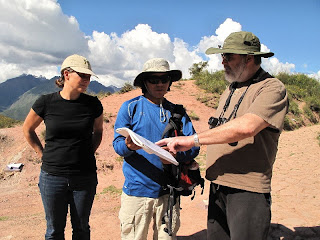
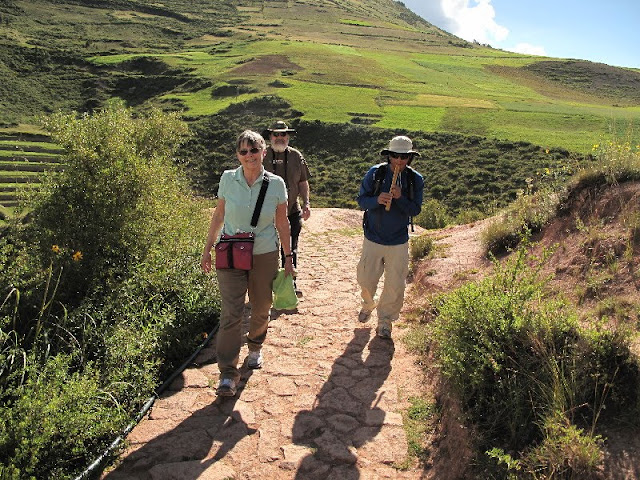
After lunch we drove up to the amazing ruins of Moray, concentric circular terraces dug into a depression in the land.   With Juan playing Andean songs on his Qena (Andean flute) we walked along the rim of the abyss as the neon-green landscape exploded all around us, bathed in the light of the equatorial sun. 
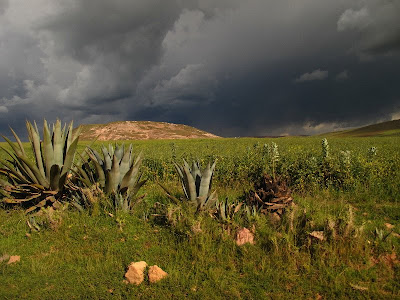
The sun soon gave way to an isolated but powerful storm.  The contrast between the two was amazing.  Driving directly through it I watched two bolts of lightning strike hills right next to us.  Nilo didn't skip a beat.  He was a really great, affable, and most importantly, cautious driver.  I sat up front with him the whole day.  He told me about a couple of great treks to do including one to the hotsprings of Lares where he claimed with a crooked smile and raised eyebrow that on certain, moonless nights, all the women from the countryside sneak into the pools to wash themselves --completely naked. 
Once back in Cusco it was cold!  But thanks to this gift from my brother David I was well prepared.  That's pure alpaca baby!
The next day,  Krista and I had to go to work, and Isabel did her first stint as a bilingual tour guide.  She and Marian and Lyle headed off to Lago Titicaca and the floating islands of Puno for a three day adventure.  They took a bus to Puno, spent a day boating around the islands and then rode the exceedingly fancy train back to Cusco.  By all accounts, Puno is a very, very, very high place.  Grandma went as far as to say she wouldn't recommend a visit to Puno to "old" people.  They got back just in time to welcome their son Matt, who arrived the next morning.   


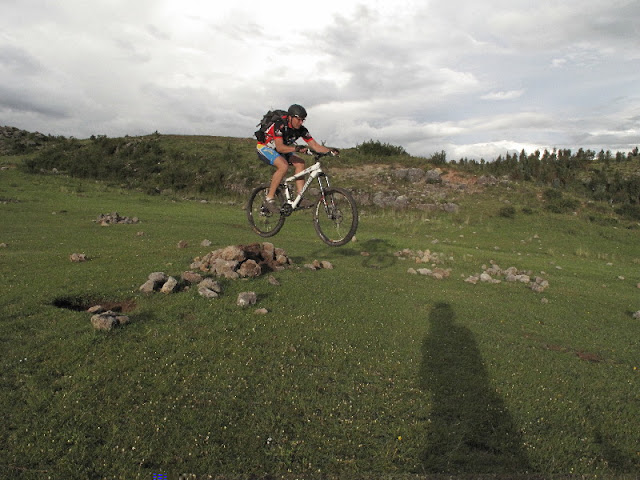
Matt is a big cyclist and I couldn't wait to get him out on the amazing trails of Cusco.  We rented a bike from my friend Dougie and got right to it.  We had great weather and did my usual route -- climb up around 1300 feet to 12,800 feet, and then bomb back down to San Blas.  Matt claims he is no downhiller, but he flew down the mountain with greatest of ease.

Me too.


 Mom and Dad left on Sunday afternoon, and got back to Kansas City without a hitch.  I can only imagine how happy Oliver, super poodle, was to see them.  I wonder if he smelled us on their clothing.

Monday was a really important day for Cusco, the benediction of Señor de los Temblores (the Lord of the Earthquakes).  According to the legend, during an enormous earthquake in Cusco the statue now known as Señor de los Temblores was rushed out of the crumbling church, and as the light of day illuminated his face, the quake abruptly halted.  The plaza was absolutely choked with believers and onlookers alike as the holiday was commemorated, and the church was surrounded by hundreds of police officers.  The girls and I left before the benediction, but Matt stayed until the end and reported a serious lack of respect for personal space at the height of the celebration.
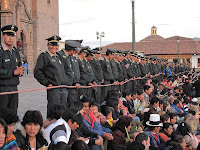
 
As I write this Krista, Matt and Isabel are on a four day trek through the mountains to the north of Cusco with Juan Pedro.  If all went according to plan they crossed a 15,000 foot pass yesterday!  Sophia and I have been having a good time together, but she has had her teary moments.  She ate dinner the first night with, I kid you not, a pair of Isabel's dirty jeans wrapped around her head to get her scent.  I jokingly refer to her as our little barbarian, but truth be told, she is very much in touch with her animal-self.  Below she can be seen in self-imposed exile after some sort of tiff. 
It's hard to believe that it's April already.  It looks like we are going to have a pretty routine month with no more visits or travel planned for the time being.  I think it will do everyone good to have a bit of routine back in our lives after three months of wonderful guests and adventures.  It feels like July is a lifetime away from now, but as we find our stride in our Peruvian life, the time seems to find its stride too.  I am making an effort every morning to burn the mountain view from our bedroom into my memory, and every bike ride I am trying to remember the way my body felt flying through the air or bumping down some ledgy track.  Because I know that someday, sooner than I think, we will be heading home.

Saturday, March 27, 2010

The Right Thing

Poor little Flor.  She is our neighbor, ten years old, and her house collapsed a few weeks ago due to the torrential rains that fell this year.   She's a third grader and she hasn't missed a day of school since the incident that could have easily taken her life and those of her entire family.  Luckily no one was in the house when it fell.  She and her family have squeezed into a neighbor's spare bedroom in the interim.

Flor goes to school every day, and then as soon as she gets home she changes into a traditional outfit from her father's hometown of Lares.  She grabs her pet alpaca, Oso, and pulling him by his lead races down to the central plaza to ask any tourist she sees to take a photo of her for a Sol (30 cents).  She's a sweet girl with a bright smile and a robust work ethic. She has been over to play with Sophia and Isabel a few times and has shared dinner with us and gotten help from us on her homework.

Right after the accident we bought the family some pots and pans since theirs were buried under many feet of mud and debris.  We gave Flor and her little sister clothing that we didn't need and bought some extra food to drop off at their door whenever we went to the grocery store.  Today, I made good on my promise to Flor to buy her some new pants.  Only one pair survived the collapse of her house.  I went down to El Molino to pick some out, and found a nice collection of jeans at one of the stalls.  The owner of the stall quoted the price at 45 soles a pair.  I explained why I was buying them and without batting an eye she chopped her price in half.  She told me I would be blessed by God and kissed me on my cheek.  The vast majority of Peruvians have been affected in some way by the disastrous rains that fell this year, so I presume they have a heightened sense of empathy and generosity for their countrymen.

As the sky continues to brighten each day,  the muddy sidewalks are transforming into dusty ones.  The stomachache of worry that came with each soaking rain is now a memory and the scorching sun makes us squint our eyes and walk on the shady side of the street.  Things here in Cusco are looking up lately, and everyone is breathing a sigh of relief.