
As an aside, I have to explain that my mother, throughout her trip to Peru was glued to a tell-all book about our former neighbor and acquaintance, Bernard Madoff. Here we were, traveling through what is arguably the most fantastic and intact set of pre-columbian ruins in the Americas, and my mother was fixated on gossip about Madoff and his infamous ponzi scheme.
While walking down from the Ollantaytambo ruins Di-di was laden as usual with the most ridiculous assortment of unnecessary items. She had scarves, reading glasses dangling from her neck, her camera on a lanyard, a variety of sweaters, a walking stick, and a large brown bag containing tissues, journals, bottles of lens cleaner, and purloined baked goods and dinner mints from whatever restaurants we had visited in previous days. In addition to this payload was the "Madoff Chronicles" held against her chest.
The path was not smooth and was somewhat exposed as it paralleled a fast moving irrigation ditch. Sure enough, Bernie's book of secrets fell out of her arms and plopped squarely into the rapidly moving water. I heard mom yell "Ohhh!" and saw a black book floating down the stream past me. I had no idea what this book was -- I assumed it was one of her journals (she keeps a few in that brown bag) -- so I went into high-alert rescue mode. I tore down the path overtaking the floating tome, and dropped to my belly in order to grab it before the channel went underground. Submersing my arm up to the elbow I wrapped my fingers around the binding and yanked it from the water. To my surprise and chagrin I had not rescued an irreplaceable relic with anecdotes written in my mother's hand about her many trips. No, I had in my hands a collection of the most puerile tidbits concerning the life of Bernie Madoff.
The irony of rescuing this chronicle of thievery from the rushing waters of a canal built by a culture whose entire existence had been stolen by the Spaniards was not lost on me. As my brother said, the only disappointment with the outcome was that I didn't let the Madoff Chronicles float down to the river, out of our reach and out of our lives forever.
Sunday, November 22, 2009

Saturday, November 21, 2009
A Day in Patacancha, Huilloq, and Ollantaytambo (by Lawrs)
My brother thought it might be a good idea to do an organized tour of the Sacred Valley of the Urubamba River on Sunday, and it turns out he was absolutely right. The cost was significant, but having the use of a solid vehicle (complete with capable driver) and a knowledgeable guide made our day really amazing. At 9:30 AM the six of us boarded a spacious Mercedes Sprinter with our guide, Erica, and our driver, Ronald. Our itinerary was to head north to Ollantaytambo and then up, up, up to the villages of Huilloq and Patacancha, both above 12,000 feet in elevation. We would eat a picnic lunch and then end the day with a walking tour of the riverside ruins of Ollantaytambo, one of the last holdouts of Mancu Inca after his escape from Spanish occupied Cusco.
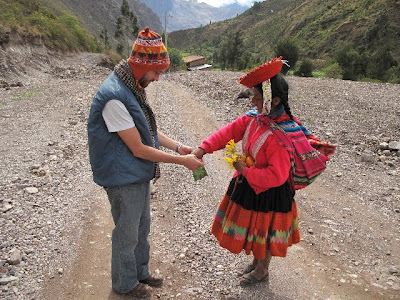
Our first stop in Ollantaytambo was all about shopping. In return for intruding on their turf, the rural folks appreciate a bit of an incentive. Instead of just handing out money (which may be spent on less healthy treats like candy, alcohol, cigarettes, etc.) many tourists have made the switch to handing out wholesome goods ranging from bread and fruit to pencils and notebooks. We walked through town and picked up bags of coca leaves to share with the grownups and bread and pencils to give to the kids.









Our first stop in Ollantaytambo was all about shopping. In return for intruding on their turf, the rural folks appreciate a bit of an incentive. Instead of just handing out money (which may be spent on less healthy treats like candy, alcohol, cigarettes, etc.) many tourists have made the switch to handing out wholesome goods ranging from bread and fruit to pencils and notebooks. We walked through town and picked up bags of coca leaves to share with the grownups and bread and pencils to give to the kids.

Once we had our booty ready to distribute we drove up a narrow, cratered dirt road for forty minutes past enormous cliff faces dropping thousands of feet to the valley floor. Bit by bit the trees began to thin and finally disappeared as we passed above 12,000 feet. We had arrived in the small town of Patacancha.

Patacancha is a village where the traditional way of life is "preserved" (insofar as this is actually possible in this age of ubiquitous internet access and cell phones...) through tourism and international grants that help the local people sell their weaving to a global clientele. As soon as we stepped off the bus, men and women in brightly colored clothing began to shuffle towards us with heavy lliqlas full of their work suspended on their shoulders. It was business time in Patacancha.

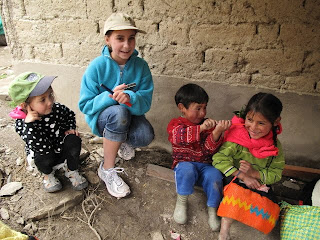
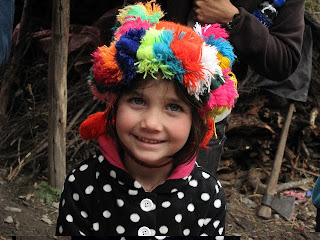
We made our way down into a courtyard where a group of five women, most with their children at their side, had spread out a selection of hats, belts, capes, skirts, vests, shawls and dolls for us to buy. There were two men who set up apart from the women and had only blankets and belts for sale. My brother and I shared coca leaves with the men while Sophia and Isabel played with the local children, distributing pencils to them and tying on their hats. I too took a hat for a trial run as evidenced in the photo below. Krista was helping my mom bargain in Quechua and we all eventually bought some really beautiful weavings.


Heading back toward Ollantaytambo we came to the town of Huilloq, which has a warehouse built by an NGO for the display and sale of textiles. This was a larger town than Patacancha and there were a lot of kids following us around to get bread and pencils. We actually burned through all 30 loaves in about ten minutes. I asked the kids about their school and was happy to hear that they enjoyed it and that they were learning in both Spanish an Quechua. Some of the smaller kids were fascinated with Sophia and Isabel and wouldn't leave their sides.

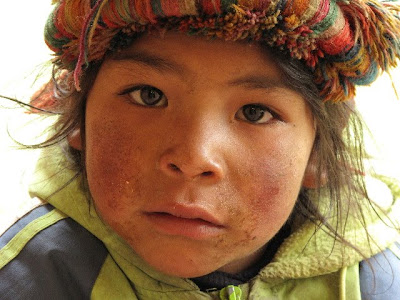
It was sobering to see how some of the children were barefoot, walking through the muddy dirt paths with filthy clothing and filthy faces. On the other hand, it was amazing to see how that didn't really make any difference to Sophia and Isabel. Kids are kids, and they all had a really nice time talking and playing together despite the vast differences between their lives. 

We stopped in a pull-off on the narrow road where Ronald and Erica feverishly set up a picnic table and brought out platter after platter of amazing food for our picnic lunch. The quality of the setting was commensurate with that of the food and there was so much of it that we couldn't come close to finishing it. We stopped campesinos who were walking by to offer them fruit and bread to carry back to their houses. David also shared some coca with a woman who was so excited to get some.


After packing up our lunch and getting back in the van we continued back down the valley toward the ruins of Ollantaytambo. The walls of the valley were striking in the late afternoon light.

The ruins of Ollantaytambo are squeezed into a tight drainage on the south side of a small, but steep mountain. There are terraces climbing up to a temple with commanding views of the valley below in every direction. The stones used to build this temple are impossibly large. They were quarried 12 kilometers from the construction site and then transported here (how exactly they were moved is still up for debate) and assembled with such skill that you could not pass a piece of paper between the mortarless joints. Someone told us that the Inca used this particular pink granite because of its high quartz content. Quartz crystals were prized for their "energy content" and so were a perfect choice for the walls of the Temple of the Sun. Whether or not you believe this, the visual impact is breathtaking.


The path from the Temple of the sun across the sheer face of the mountain to another set of terraces was airy, to say the least. We began our descent to the river as the sun sank behind the ridges defining the valley. We walked along the elaborate irrigation canals laid out on the valley floor on the way to the van.

The day was honestly mind boggling, almost too much to take in in such a short time. On the drive back we could see big storm clouds over Cusco to the south and we were very thankful that we happened to be where the rain wasn't on this long and extraordinary day.

Wednesday, November 18, 2009
La Maravilla que es El Valle Sagrado
The Di-di (my mom) and brother David arrived in Cusco last Friday, and we have had extraordinary adventures together. I am afraid that if I try to squeeze everything we have seen and done into one blog post that it will be interminably long. So I will try to write chronologically until my fingers start to bleed, and then I will take a break to recuperate for the next entry.
We picked Mom and David up at the airport in a van with a driver and headed straight for the town of Urubamba in the Sacred Valley. Urubamba is at around 9000 feet above sea level and is therefore an easier place to acclimatize to than Cusco (11,500 feet). The drive was relatively uneventful until the last twenty minutes when we negotiated what felt like a hundred hairpin switchbacks, descending 2000 feet to the Urubamba river.

Our "hotel" was actually an enclave of gorgeous, free standing homes. We had our own adobe villa and with it came the lovely and talented Bertha, our own cook! Upon arrival we were served a delicious meal while sitting in one of the exterior courtyards near the kitchen.

The gardens on the grounds were stunning. Living in Cusco we don't see a lot growing out of the ground and there is a palpable paucity of flowers. But here in Urubamba the flowers were exploding with vibrant petals of every hue and you could hear the honey bees hunting for nectar from fifty feet away.


 After an amazing dinner we decided to go the next day to one of the Incas' most unique ruins, the agricultural terraces known as Moray. The three sets of concentric, descending circles are thought to have been a center of crop hybridization and experimentation. Each terrace in the complex was its own micro-climate with differing degrees of humidity, solar exposure, water saturation, and temperature -- the perfect laboratory for the development of robust crops, a necessity of life when farming at such high altitudes. Once again, the way these ancient engineers worked with the land was as logical as it was inspiring. Walking down to the bottom circle was exciting on the tiny steps protruding from the walls and descending diagonally down into the abyss.


We picked Mom and David up at the airport in a van with a driver and headed straight for the town of Urubamba in the Sacred Valley. Urubamba is at around 9000 feet above sea level and is therefore an easier place to acclimatize to than Cusco (11,500 feet). The drive was relatively uneventful until the last twenty minutes when we negotiated what felt like a hundred hairpin switchbacks, descending 2000 feet to the Urubamba river.


The gardens on the grounds were stunning. Living in Cusco we don't see a lot growing out of the ground and there is a palpable paucity of flowers. But here in Urubamba the flowers were exploding with vibrant petals of every hue and you could hear the honey bees hunting for nectar from fifty feet away.


The Urubamba river leads from the bottom of the Valley housing Cusco through a series of towns on its way to the Amazon. The most noteworthy settlement that the Urubamba river passes by is Machu Picchu, but there exist the extraordinary ruins of Pisac, Huchuy Cosqo, and Ollantaytambo on the way there. The river valley is host to amazingly fertile land and is still one of the most prolific sources of produce in the region. But I digress...
THERE WAS A SWING SET IN THE COURTYARD!!!! We were all warmed to the core to see Sophia's and Isabel's unbridled joy while running across a lawn(!) towards the swings. I think they played there happily for an hour and a half, until it was too dark to continue.


 l
lThis place felt so much more familiar to us all. Birds chirping, water close by, grass under foot -- it reminded us of what we love the most about living in Maine.
 After an amazing dinner we decided to go the next day to one of the Incas' most unique ruins, the agricultural terraces known as Moray. The three sets of concentric, descending circles are thought to have been a center of crop hybridization and experimentation. Each terrace in the complex was its own micro-climate with differing degrees of humidity, solar exposure, water saturation, and temperature -- the perfect laboratory for the development of robust crops, a necessity of life when farming at such high altitudes. Once again, the way these ancient engineers worked with the land was as logical as it was inspiring. Walking down to the bottom circle was exciting on the tiny steps protruding from the walls and descending diagonally down into the abyss.


We went back to the town of Urubamba and ate lunch at a fancy Hotel that shall remain nameless in exchange for permission to swim in their pool. The girls had a blast while el Quehon Daddy watched from the sidelines. It was a very full day and we took it easy in the evening, sitting in the "mini-moray" fire pit after another nice dinner. Our first full day in the Sacred Valley was disorienting in the best possible way: lush, visually stunning, warm, and teeming with life.

Thursday, November 12, 2009
Funny, ha ha (by Lawrs)
We are looking for a new refrigerator, and we told our Spanish teacher about it. She said she had just happened to see an ad for a slightly used fridge on the wall of a store this morning. So after our Spanish lesson Isabel and I trotted over to said store for a look-see. Sure enough, there was the ad and the woman who wrote it standing there beside it. She told us the fridge was basically new but she was moving to Argentina and needed to sell it. She told us where her apartment was and instructed us to yell up to the second floor for "Flavio" once we got there.
Walking along the pedestrian street called Tanda Pata we passed a posse of police officers, excusing ourselves as we walked by. Not 100 feet further down the street two of the officers went jogging past us. I figured there must be some sort of foul play going on as these two were in quite a rush. Like ambulance chasers we pulled right into their slipstream preparing to veer off to our street while they kept going straight. As it turned out they too headed down the street that we were sent to. They marched right up to the door that we were supposed to knock on and yelled up to the windows "Flavio! Baja por favor!" (Flavio, come down here please). Flavio stuck his head out the window and, with a worried look on his face did a double take at the cops in the courtyard.
So. Just who was this Flavio, and what was going on here? Had we stumbled onto some sting operation?
Feeling brave and trying to solve the puzzle, I asked one of the cops if by chance they were there to buy the stuff for sale. Yes they said, how about you? Yup, us too, but we just want the fridge. We all got a chuckle out of the circumstance, especially poor Flavio who was quite relieved after the shock of having two police officers pounding on his door. In the end the fridge was nice, but probably too small for our needs.
Later in the day (why oh why did I not have my camera?!) we went down to the street to play with some new friends that Isabel and Sophia have made. There is a family with four daughters that makes and sells beautiful jewelry on the street corner outside our house. The daughters are Ruth (6), Yanet (8), Mari-Luz(10), and Lizbet(12), and they are such sweet kids. They hang out in the street after school lets out every day. Sophia likes to sort buttons in the dress shop downstairs with Ruth and Yanet while Isabel and I go over her math work while Mari-Luz and Lizbet look on. Yesterday Mari-Luz wrapped Sophia up in a "lliqlla," the ubiquitous woven cloth carried on the back and tied under the neck of any campesino carrying babies or supplies. Their sat Sophia, all smiles, on Mari-Luz's back, being carried around in the campesino version of a backpack. It was a great moment.
I am really happy that the girls are beginning to make friends here. It's also really good for all of us to be speaking Spanish -- and speaking with children is an excellent way to learn. I'll try and get downstairs with a camera the next time we play.
Walking along the pedestrian street called Tanda Pata we passed a posse of police officers, excusing ourselves as we walked by. Not 100 feet further down the street two of the officers went jogging past us. I figured there must be some sort of foul play going on as these two were in quite a rush. Like ambulance chasers we pulled right into their slipstream preparing to veer off to our street while they kept going straight. As it turned out they too headed down the street that we were sent to. They marched right up to the door that we were supposed to knock on and yelled up to the windows "Flavio! Baja por favor!" (Flavio, come down here please). Flavio stuck his head out the window and, with a worried look on his face did a double take at the cops in the courtyard.
So. Just who was this Flavio, and what was going on here? Had we stumbled onto some sting operation?
Feeling brave and trying to solve the puzzle, I asked one of the cops if by chance they were there to buy the stuff for sale. Yes they said, how about you? Yup, us too, but we just want the fridge. We all got a chuckle out of the circumstance, especially poor Flavio who was quite relieved after the shock of having two police officers pounding on his door. In the end the fridge was nice, but probably too small for our needs.
Later in the day (why oh why did I not have my camera?!) we went down to the street to play with some new friends that Isabel and Sophia have made. There is a family with four daughters that makes and sells beautiful jewelry on the street corner outside our house. The daughters are Ruth (6), Yanet (8), Mari-Luz(10), and Lizbet(12), and they are such sweet kids. They hang out in the street after school lets out every day. Sophia likes to sort buttons in the dress shop downstairs with Ruth and Yanet while Isabel and I go over her math work while Mari-Luz and Lizbet look on. Yesterday Mari-Luz wrapped Sophia up in a "lliqlla," the ubiquitous woven cloth carried on the back and tied under the neck of any campesino carrying babies or supplies. Their sat Sophia, all smiles, on Mari-Luz's back, being carried around in the campesino version of a backpack. It was a great moment.
I am really happy that the girls are beginning to make friends here. It's also really good for all of us to be speaking Spanish -- and speaking with children is an excellent way to learn. I'll try and get downstairs with a camera the next time we play.
Monday, November 9, 2009
Tipon
Isabel and I just realized that we never posted any pictures of our trip to Tipon, so here goes! Back in mid-October we spent a day visiting some of the ruins south of Cusco. Tipon is the site of a natural spring that comes bubbling up out from the base of a mountain. The Inca built a series terraces and canals here to use the spring for irrigation.


Tipon feels like it belongs where it is. It blends seamlessly with the valley, the spring, and the surrounding mountains. My friend Julie who lives in Colorado but hails originally from the Northeast always complains about the way homes in the Western United States are plopped down on the land without any feeling for the site on which they sit. In contrast, many old homes in rural New England were usually carefully planned around the shape and feeling of the land on which they were built. I agree with Julie, but the Inca took the feel of the land to a whole different level. Tipon is an extension of nature, an embellishment of what was already put in place by the forces of geology.


The Inca made blessings to countless landforms in the diverse territory that they occupied. I can only imagine how significant a spring might have been to a civilization trying to grow subsistence crops in the high desert environment. Tipon was undoubtedly a very holy place to the Inca, and I could still feel that energy, nearly five hundred years after this land was wrested from its stewards.

While the construction of the site is amazing, what made the greatest impression on me was its placement and orientation. Krista asked me to climb up behind the highest terrace to take a photo, and from that vantage point I had the distinct feeling that whomever designed Tipon cared very much about the way it was shaped and what it looked out onto.

The terraces along the outer edge of Tipon follow the contours of the valley in which it sits. As your eyes move towards the center of the site you can see that the terraces gradually become more linear. The steps to get from one terrace to the next are massive field stones protruding two feet from the stone walls, ascending at an angle. The lower steps make excellent benches for four year olds.


The Inca made blessings to countless landforms in the diverse territory that they occupied. I can only imagine how significant a spring might have been to a civilization trying to grow subsistence crops in the high desert environment. Tipon was undoubtedly a very holy place to the Inca, and I could still feel that energy, nearly five hundred years after this land was wrested from its stewards.
Thursday, November 5, 2009
The things one gets used to... (by Lawrence)
Isabel and I have been taking Spanish classes in a new part of town this week. New to us anyway. By the look of things, the neighborhoods we walk through on the way to the language school have been around for a long, long time. We were in such a rush to get to the school on the first day that we somehow missed the scads of Inca walls all around us.

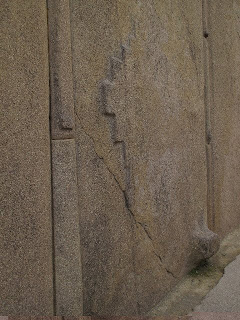
The Inca masons had many styles of building with stone. By some estimates Machu Picchu alone (the one-time private vacation estate of the Inca King Pachacuti) has over 100 different stone-working styles distributed among its structures. So as we walked back to our house after classes today, Isabel and I meandered slowly and stopped to see what was around us. We were amazed. These builders had no saws or tools made of steel, yet some of their blocks are so uniform that it's hard to make sense of. Other blocks are like puzzle pieces that fit together just so.


And then there is the more free-form style that resembles collage. My hunch is that if I had been a stone mason during the time of the Inca Empire, this would have been my area of expertise. It looks pretty improvisational, no?

Then, as we climb the narrow streets toward our house, there are the equivalent of Charlie Parker compositions made of stone. You can tell that these artists had complete and total control of their medium. Check out the shapes made to fit together. Also remember that the Inca did not use any mortar in these types of constructions. All the blocks had to fit together perfectly.

One of the more striking styles of stone building has been dubbed the "Cyclopean Style." Look at the size of these stones compared to Isabel and remember that the Inca did not use the wheel. They did however use logs to convey their stones from the quarry to the construction site. Still, can you imagine the coordination and skill it took to build this wall?

After two months in Cusco I feel a bit like the New Yorker who spends his life in the city, but doesn't bat an eye when some new, enormous skyscraper goes up. Such is the lure of the local. None of us wants to be that camera wielding, gawking outsider. But today I am glad we took the risk of appearing to be tourists, although it did have its drawbacks. An elderly lady thought she had us pegged and began pulling a variety of wares from her plastic bag for us to buy. After some conversation that wasn't getting us any further from her sad eyes and chants of "comprame casero" I just gave her some money for nothing in return. She told me she wished I would have good luck and success in my life.
So far, so good.
Tuesday, November 3, 2009
Dia de los Muertos

Our apartment complex, which was empty save for us for the first month and a half, has filled up quickly with other gringos. The big apartment across the courtyard is being rented by a Shamanic healer from Utah who was previously a special education teacher. She is sharing the space with an American pediatrician who was nearly killed here three years ago when a house sized boulder rolled down a cliff and onto the bus she was traveling on. Our newest neighbor is right below us and is such a sweet guy. He was a finance director for the mayor's office in Denver and he and his wife (a landscape architect) are retiring to Cusco. He is enormously generous and has offered to help us in many ways already. It's nice to have this little community forming around us.

The girls and I visited the city cemetery on the Day of the Dead. It was quite different from what I remembered in Bolivia. In Bolivia families basically planted themselves graveside and sang songs, made blessings, drank a lot, and laughed and cried remembering their deceased relatives. The scene in Cusco was in comparison totally subdued. The cemetery is more of a mausoleum with ornate diorama-like scenes stacked six high in narrow passageways. Instead of singing and drinking most people were busy polishing the brass frames of the dioramas or spraying the glass with windex. I didn't see anyone drunk the whole day which felt kind of weird. The Peruvian version of this holiday is more somber than what I remember in Bolivia. There was sadness in Bolivia to be sure, but also a lot of laughter and song.

We are continuing to settle into our routines here. I am hoping that we can add some time volunteering in schools/orphanages to our schedule. We ate dinner last night at a lovely place that exists to fund a school program for impoverished kids. A seventeen year old boy quit high school and decided to create a charitable foundation funded by a restaurant. The place was decorated like a page from a Dr. Seuss book and the food was amazingly fresh and delicious. It was inspiring to see what this idealistic kid was able to accomplish. There is such an abundance of charitable organizations here that it's hard to understand how anyone is still impoverished. There are a lot of people here trying to help the poor.
Well, the dishes are not going to wash themselves... Goodnight all.
Subscribe to:
Posts (Atom)